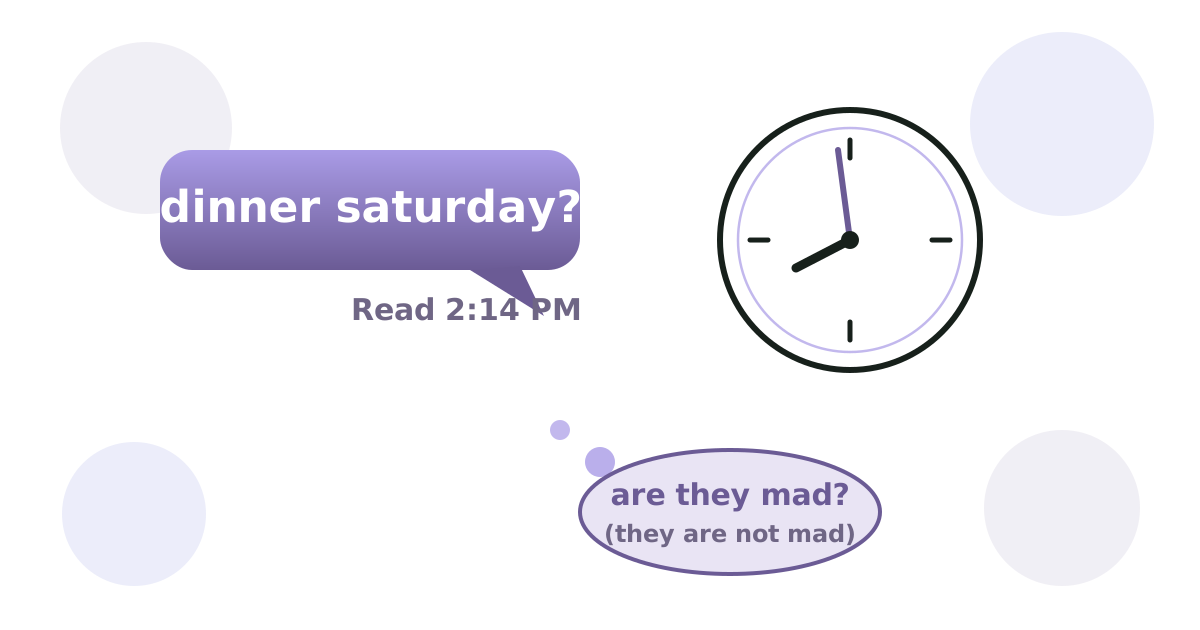
Read at 2:14 PM. It's now 9:40 PM, and in the hours between, you've drafted an entire narrative: they're upset, they're pulling away, you said something wrong at dinner. Then the reply arrives — cheerful, ordinary, with an apology about a chaotic day — and the story collapses. Sound familiar? The gap between "read" and "replied" is where modern anxiety does its best writing.
What a read receipt actually tells you
Technically: that the message was displayed on a screen. That's all. It doesn't say whether they read it properly or glanced while on a call. It doesn't say what they felt. It certainly doesn't say why they haven't replied. But because it's the only data point silence offers, we assign it enormous meaning — and the meaning we assign is usually imported from our own state, not theirs. Anxious? The silence is rejection. Guilty? It's judgment. As with ambiguous texts generally, the less information there is, the more of ourselves we pour in.
What slow replies actually correlate with
Here's the deflating truth: response time, by itself, is one of the weakest signals in texting. It correlates with being busy, with phone habits (some people batch messages like email; some answer nothing after 9 PM), with message type — anything needing a real answer waits longer than "lol" — and with personality. Chronically slow repliers are slow with everyone, including people they adore.
What it correlates with far less than we assume: interest. The folk theory that reply speed maps to how much someone cares collapses on contact with one busy week.
The signal is the pattern, not the gap
A single slow reply means nothing. What means something is change and shape over time — the same logic as reading mixed signals:
- Baseline shifts. A same-hour replier who now takes days, consistently, with no life change you know of — that's data. A slow replier being slow is Tuesday.
- What arrives, not when. A thoughtful reply after six hours beats an instant "haha" every time. Judge the content; the timestamp is noise.
- Effort symmetry over weeks. Who initiates, who asks questions, who converts talk into plans. One slow evening says nothing about any of this.
How to get your evenings back
Three practical moves. First, never interpret silence in the first 24 hours — simply decline to. Most "left on read" crises resolve themselves before the next morning. Second, check the baseline before the panic: is this unusual for them? Third, if a pattern genuinely has changed, ask about it directly once — "you've seemed quieter lately, all good?" — instead of running silent forensics for a month.
And if you want the honest check before the spiral: Un.hidden reads the message — and the pattern around the person — rather than the timestamp. Decode what was actually said, see how it fits their behavior over time, and get a reply suggestion built on what you want, not on your 9:40 PM theory. The story you're telling yourself at hour seven is rarely the one the evidence supports. It helps to have something that only reads the evidence.