Somewhere on your phone right now there's a message you've read at least five times. Not because it's long. Because it's short. "ok." "Sure." "We should talk." You know every word and you still don't know what it says.
This isn't a you problem. It's a texting problem, and it's built into the medium.
Texting strips out most of the signal
Face to face, the words are only part of the message. Tone of voice, pacing, a raised eyebrow, whether someone leans in or checks their phone — all of it carries meaning, and most of it never survives the trip into a text field.
What's left is a compressed little artifact: a few words, some punctuation, a timestamp. The meaning didn't disappear, though. It moved into things we're bad at reading consciously — word choice, message length, response timing, what got left out. A "sounds good!" and a "sounds good." are one dot apart and a mood apart, and everyone knows it without being able to say why.
And here's the mechanism that actually causes the damage: when a message is ambiguous, your brain doesn't leave it ambiguous. It fills the gap, and it fills it with whatever you're already feeling. Anxious? The "ok." is cold. Guilty? It's a verdict. The less the message says, the more of yourself you read into it.
The classics everyone puzzles over
A few messages show up in everyone's decoding sessions. What makes them hard isn't the words — it's the range of things they can mean:
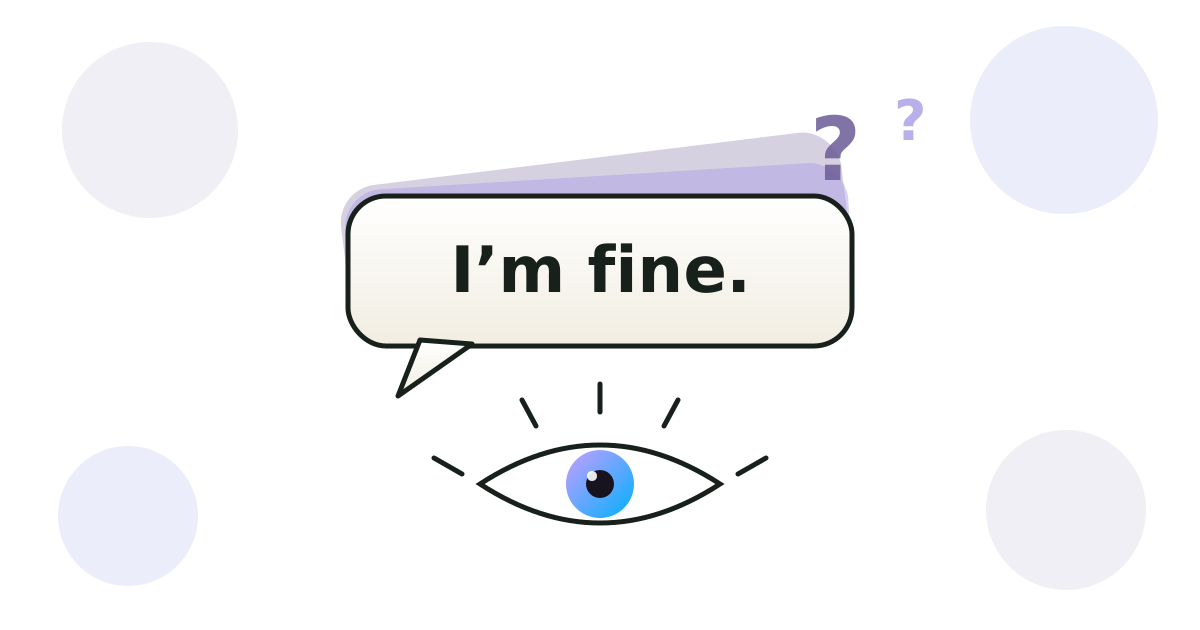
- "I'm fine." Sometimes it's exactly that. Sometimes it's the most loaded sentence in the language. The period does a lot of work, and so does everything you know about the day that preceded it.
- "Sure, whatever works." Easygoing, or completely checked out. The same words can be an olive branch or a door quietly closing.
- "We should talk." Four words that can ruin an afternoon. Usually it's logistics. The 5% of the time it isn't is why your stomach drops.
- "k" A whole genre of its own. From a busy person mid-task it means "received." From someone who usually writes paragraphs, it's a temperature reading.
- "lol" at the end of a serious sentence. The great softener. It can mean "don't worry" or "I'm saying something true and hiding it in a joke."
- The read receipt with no reply. Not a message at all, and somehow the loudest one on the list.
How to actually read a message
The mistake is treating the text as the whole evidence. The meaning is in the context around it, and a careful reader checks a few things before deciding what a message says:
- Their baseline. A one-word reply from a chronic one-word replier is Tuesday. The same reply from someone who usually sends three bubbles in a row is information.
- The timing. Sent at 9am between meetings reads differently than 1am after silence. Speed matters less than pattern: a fast "k" and a slow "k" are different messages.
- What's missing. The question they didn't answer, the plan they didn't confirm, the warmth that's usually there and today isn't. Absence is content.
- Your own state. The hardest one. If you're anxious, tired, or braced for bad news, you're not reading the message — you're reading your mood with the message as a prompt. Name that before you decide what they meant.
Do this honestly and most ambiguous texts collapse into something ordinary. The residue — the ones that stay confusing — are the ones worth taking seriously.
When you want a second opinion
This kind of reading is exactly what we built Un.hidden to do. Paste the message and it gives you three concrete answers: what they're really saying, what's going on underneath, and what you could say next. It's the second opinion you'd get from your most perceptive friend, minus the screenshot and the group chat.
And because you can tag the person behind the message, Un.hidden learns their baseline over time — so it reads that "k" against how they actually text, not against a generic rulebook. Privately, on your phone, with conversations that never get stored or shared.
The message you've read nine times? That's the one to try it on.