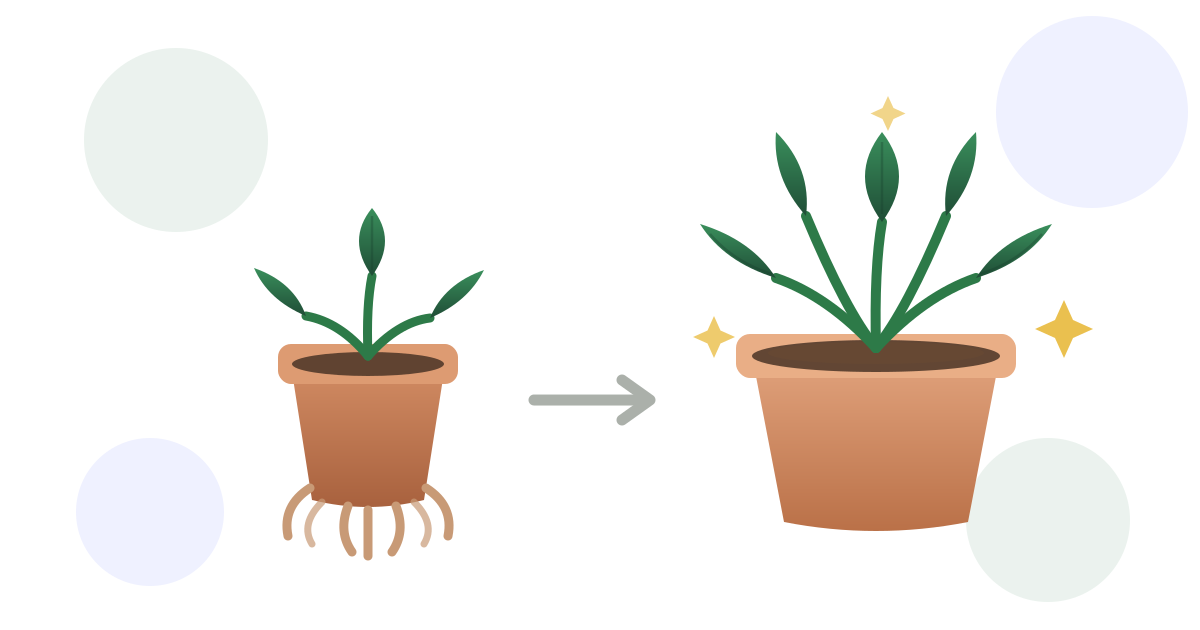
Somewhere between "I just brought this plant home" and "why does it look sad no matter what I do," there's usually a pot that stopped fitting. Repotting is one of those care tasks nobody teaches you. You either do it too often, panicking every time a leaf yellows, or you never do it at all and wonder why a healthy plant slowly stops growing.
The truth is that repotting isn't a schedule item. It's a response to what the plant is telling you, and the signs are easier to read than most people think.
The signs your plant is asking for a bigger home
A plant that has outgrown its pot will usually give you more than one hint. Look for a few of these together, not just one in isolation:
- Roots circling the surface or escaping the drainage holes: This is the clearest sign. If you see a dense mat of roots on top of the soil, or roots poking out the bottom of the pot, the plant is root-bound and running out of room.
- Water runs straight through: You water, and it drains out the bottom almost immediately without soaking in. That usually means roots have crowded out most of the soil, so there's nothing left to hold moisture.
- The plant dries out unusually fast: If you suddenly need to water twice as often as you used to, the root ball may be so dense that it can't retain water between drinks.
- Growth has stalled: A plant that was thriving and then plateaus, especially during its growing season, is often out of space and nutrients.
- The pot is bulging or the plant tips over easily: Roots can physically deform a plastic pot, and a top-heavy plant in a too-small pot loses its stability.
When NOT to repot
Repotting is stressful for a plant, so it's not something to do on a whim. A yellow leaf or two is not a reason to disturb the roots. Neither is a plant that just looks a little tired after winter.
Timing matters too. The best time to repot most houseplants is early in their growing season (spring into early summer), when they can recover quickly and grow into the new space. Repotting a plant that's dormant or already stressed can do more harm than good. And resist the urge to jump several pot sizes at once, which brings us to the most common mistake.
Go up one size, not five
The instinct is to give your plant a huge new pot so you never have to do this again. Don't. A pot that's too big holds far more soil than the roots can use, and all that extra soil stays wet long after the plant has taken what it needs. The result is soggy soil, poor oxygen flow, and root rot, which is the exact opposite of what you were trying to achieve.
The rule of thumb: move up just one size, roughly 2–5 cm (1–2 inches) wider in diameter than the current pot. That gives the roots room to expand without drowning them in excess soil. Always use a pot with drainage holes, and refresh with new potting mix suited to the plant rather than reusing the old, spent soil.
What changes after you repot
Here's the part almost nobody mentions: your watering routine has to change after repotting, and getting this wrong undoes all your careful work.
Fresh potting mix holds much more moisture than the old, root-packed soil did. A plant that used to drink every three days might now stay wet for a week or more in its new pot. If you keep watering on the old rhythm, you'll drown it in the very soil that was supposed to help it. For the first few weeks, check the soil before watering rather than assuming, and let it dry out more between drinks than you're used to.
It's also normal for a plant to sulk for a week or two after repotting: a little droop, maybe a dropped leaf. That's transplant shock, not failure. Keep it out of harsh direct sun, hold off on fertilizer for a few weeks while the roots settle, and let it recover on its own schedule.
How Leafwise keeps track for you
This is exactly the kind of context that gets lost when you're managing more than a couple of plants. When did you last repot the monstera? Did the fern get fresh soil in spring or is it still in the pot it came in?
In Leafwise, repotting is part of each plant's care history. When you log that you've repotted, Leafwise knows the soil is fresh and adjusts its watering guidance accordingly, so it won't nag you to water on the old rhythm while the new mix is still holding moisture. It also remembers how long each plant has been in its current pot, so the "your plant might be root-bound" nudge arrives when it's actually useful, not on some arbitrary timer.
Repotting shouldn't be guesswork, and it definitely shouldn't be something you find out you needed to do only after the plant starts declining. With the right timing and a watering routine that adapts to fresh soil, it's one of the simplest ways to keep a plant thriving for years.