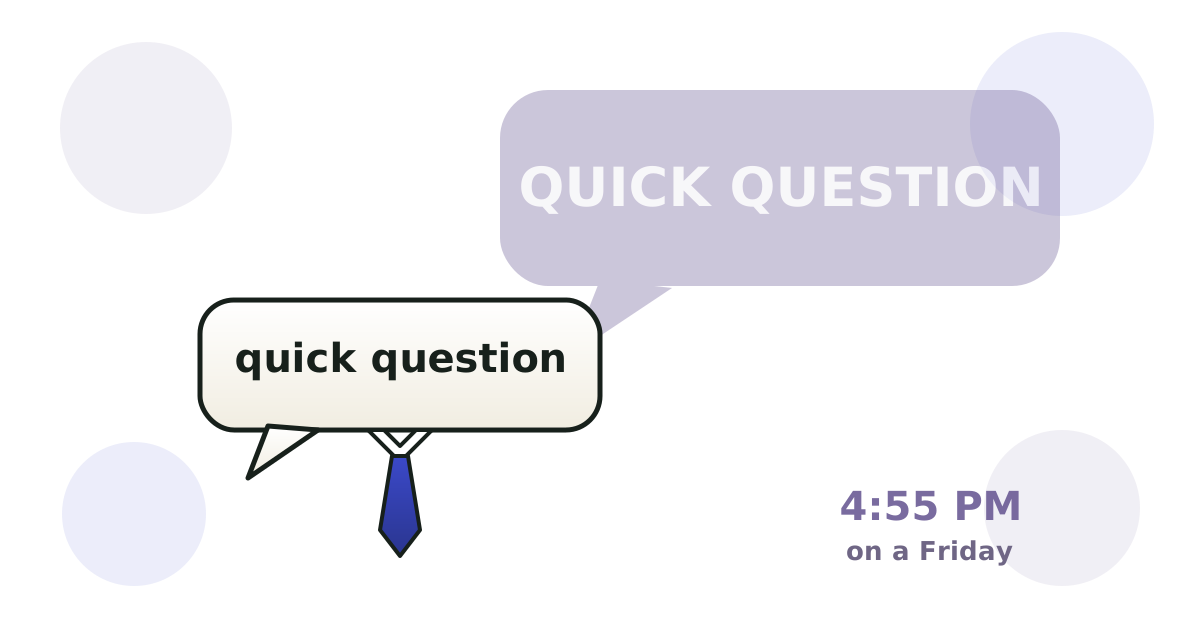
"Got a sec?" from your manager at 4:55 PM carries more adrenaline than any four words should. Work messages are their own dialect: a register where directness is risky, tone is professionally sanded down, and meaning consequently goes underground. The result is that office chat runs on subtext — and everyone is translating, all day, with no dictionary.
Why work messages are extra-coded
Three forces do it. Hierarchy: people soften or sharpen language depending on who outranks whom, so the same words carry different weight up and down. Paper trails: written channels are semi-public and permanent, so real opinions retreat into euphemism. And professional norms: you can't type what you feel, so what you feel leaks into punctuation, timing, and phrasing instead. The feelings don't disappear at work. They just encrypt.
A field guide to the classics
- "Per my last email." The flagship. Literal meaning: refer to previous correspondence. Actual payload, nearly always: I already answered this and I'm annoyed you made me say it twice.
- "Let's take this offline." Either "this genuinely needs a conversation" or "stop discussing this in front of the whole channel" — the thread it arrives in tells you which.
- "Quick question" / "Got a sec?" Usually exactly that. The reason it spikes your pulse is the ambiguity, not the odds — which is worth remembering before you spend an hour pre-living a firing that's actually a calendar question.
- "No rush!" Ranges from sincere to its exact opposite. Calibrate against the sender's baseline and the deadline math, not the words.
- "As discussed…" Often innocent recap; sometimes someone laying down a paper trail. If it subtly rewrites what was discussed, it's the second one.
- The shrinking exclamation marks. "Thanks!!" → "Thanks!" → "Thanks." from the same colleague is a genuine temperature series. People's punctuation baselines at work are remarkably stable, which is what makes drift legible.
Reading it without becoming paranoid
The skill is the same one we keep returning to in this series: judge against baseline, read patterns rather than incidents, and know your own state before assigning tone. A terse message from a terse colleague is Tuesday; the same message from your effusive teammate might be worth a check-in. One cold email is a workload; a quarter of cooling ones is a conversation to have. And the anxiety reading — where every "ok" is a verdict on you — says more about your Sunday-night cortisol than about your standing. Decode enough to navigate; don't build a surveillance program out of your inbox.
A translator in your pocket
People told us early on they were using Un.hidden on work messages as much as personal ones — one beta tester famously spotted a pattern in her manager's emails she'd never consciously registered. It makes sense: the decode (what's being said, what's underneath, what to say next) works on any message with a person behind it, and the per-person patterns are if anything more useful at work, where baselines are stable and stakes are concrete. Paste the message; find out whether "per my last email" was aimed at you or just at a long week.